AI · Alpha Omega
AI that drafts and checks. People decide.
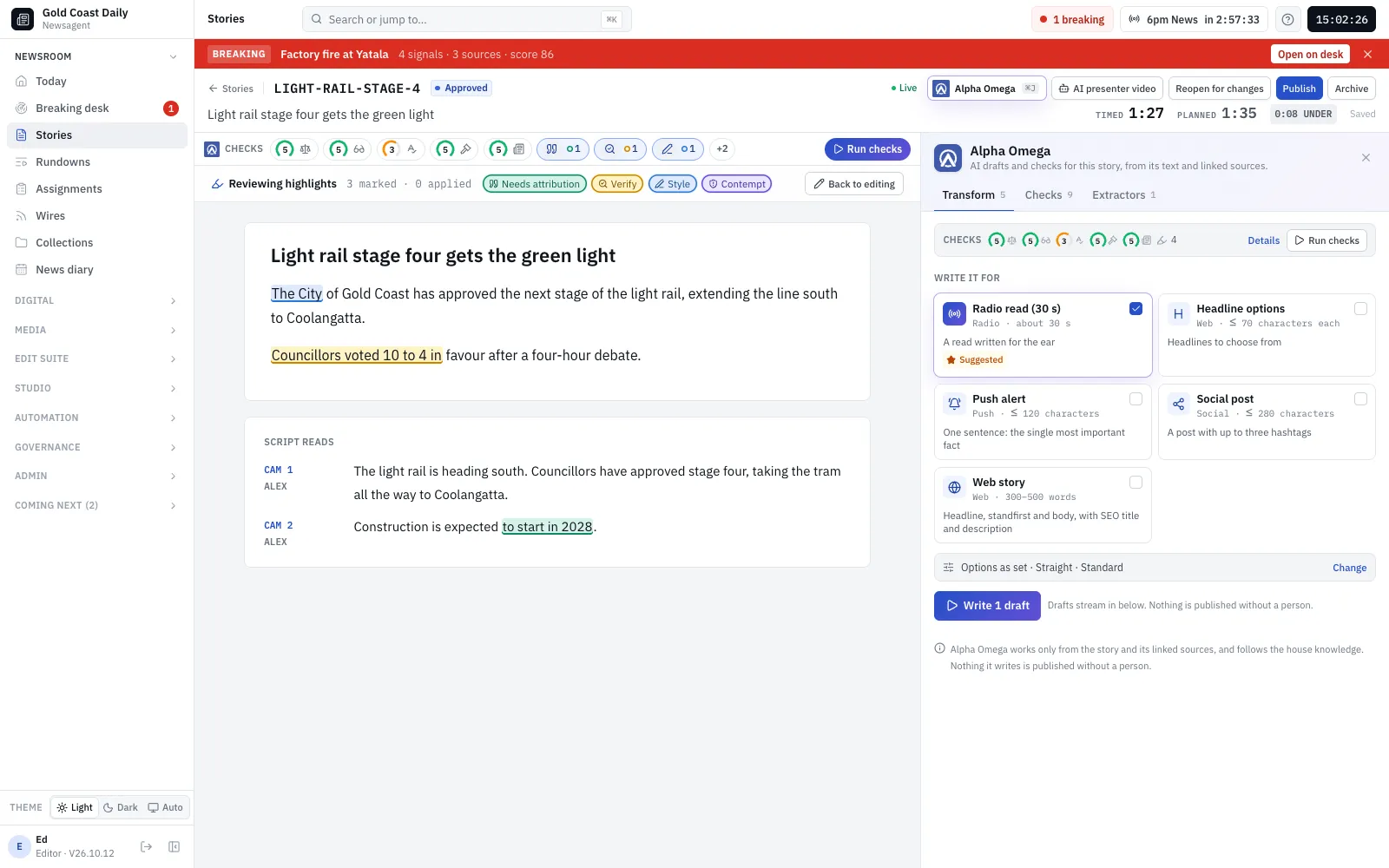
Alpha Omega is the newsroom's AI assistant, built into every story. It scores, marks and rewrites as you work, streams its answers in as they're written, and never publishes anything on its own.
Operators
Four kinds of help, each one a house tool
Alpha Omega's tools are named, reviewable operators rather than a chat box, so every newsroom knows what each one does and can tune it.
Raters
A score from 1 to 5 with the reasons: balance and bias, clarity, newsworthiness, legal risk and house style. Each shows as a small dial at the top of the story.
Highlighters
Marks on the exact words: fact check (verify, possible error, likely error), legal (defamation, contempt, privacy), house style and claims needing attribution. Accept or dismiss each suggestion.
Transformers
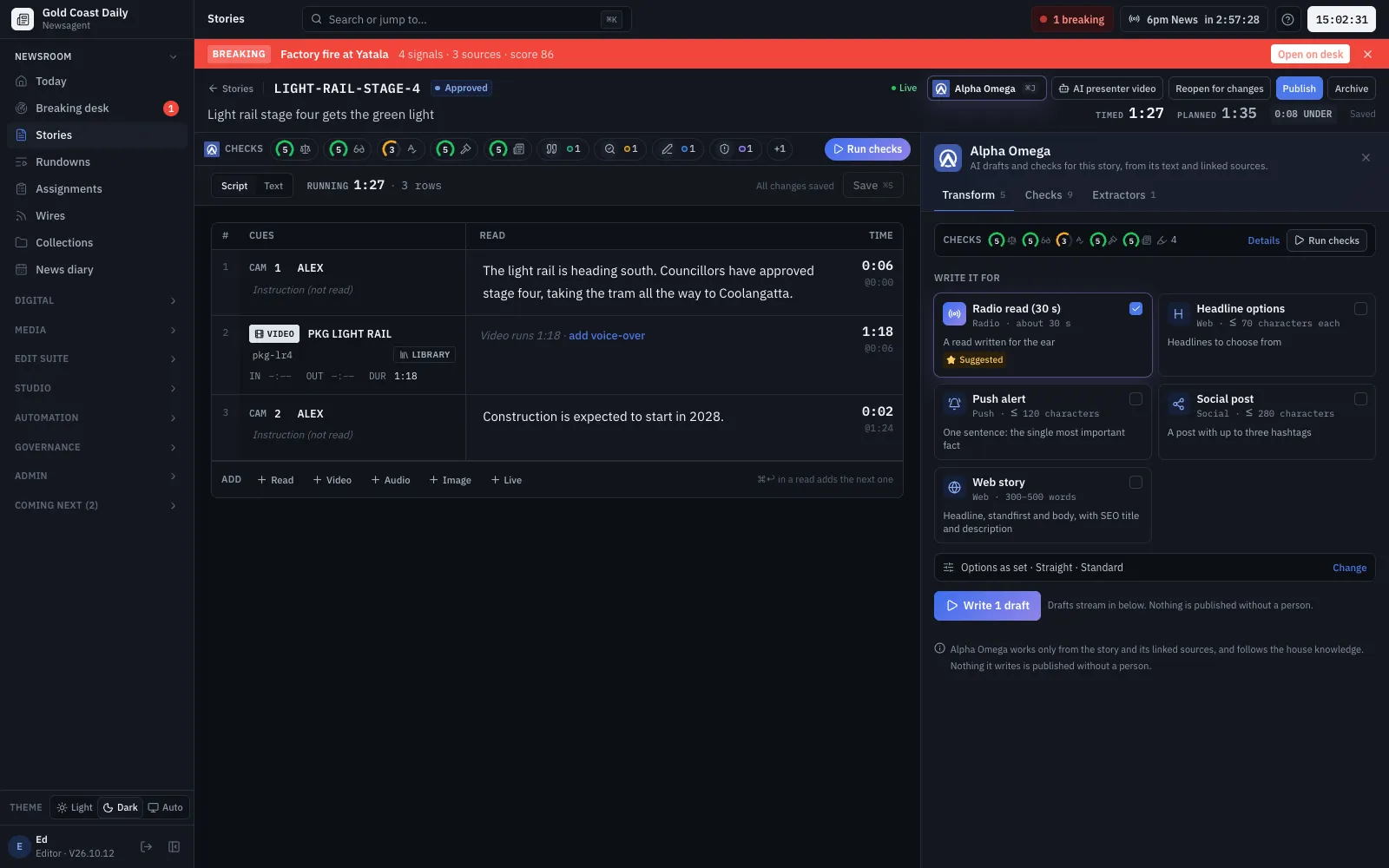
Web story, headline options, radio read, social post and push alert, with up to three options to compare, in the tone and length you ask for.
Extractors
Tags and SEO fields pulled from the story, added in a click.
How it works
How the AI tools work
Answers stream in as they’re written
Dials sweep to their scores, highlights appear on the text and drafts grow word by word, so nobody waits for a spinner. Checks can run every time a story is saved, on request, or not at all, set per newsroom.
Your house style, without fine-tuning
Your style guide, legal guidance and local names are written down once as house knowledge and given to every tool. When the style changes, you change the text: there’s no model to retrain, and the same rules apply on whichever model does the work.
Alpha Omega Studio
Paste any text and run any operator on it, to try the tools, compare models, or show a team what they do.
Models and costs
Your models, your keys, every cost on the record
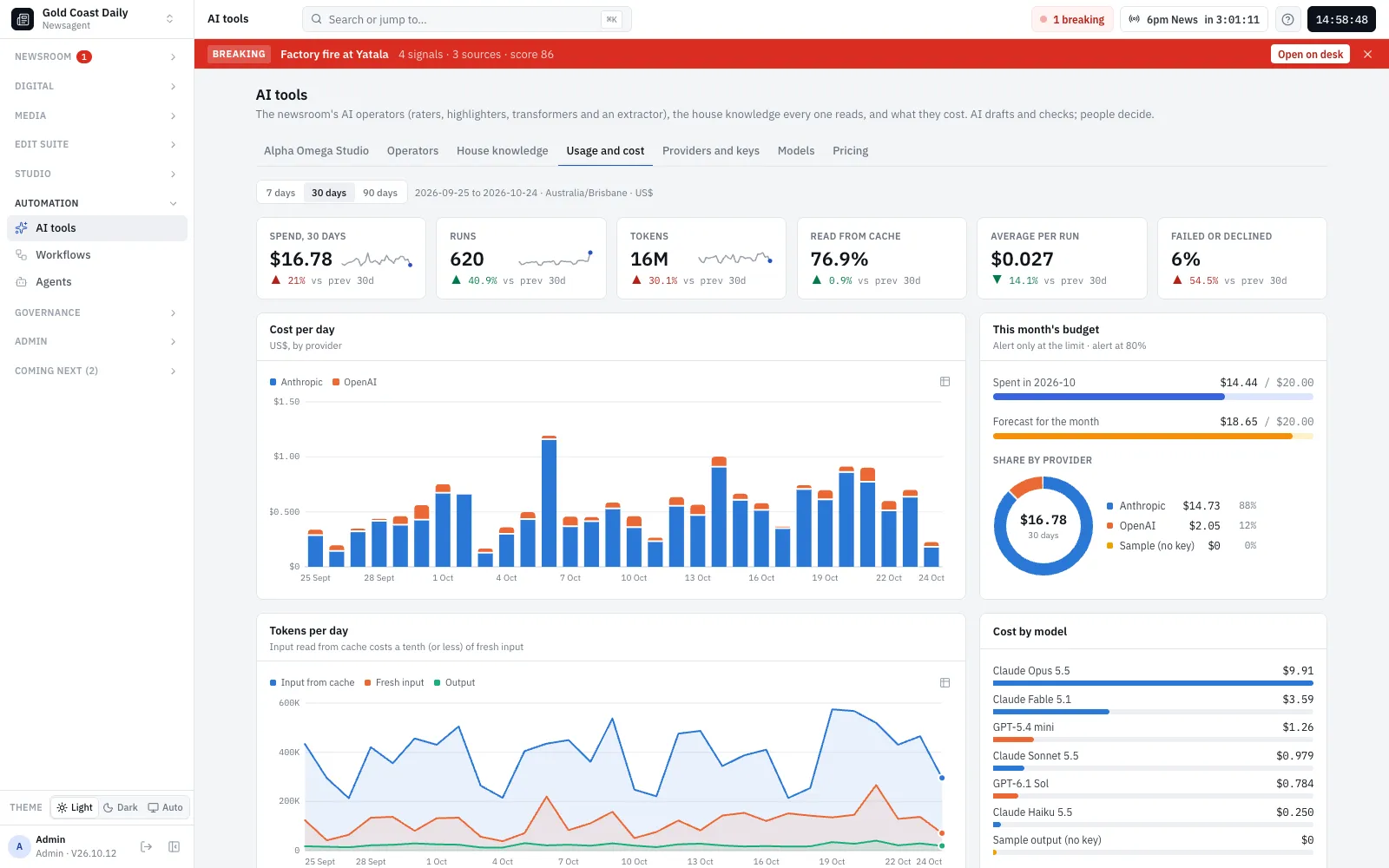
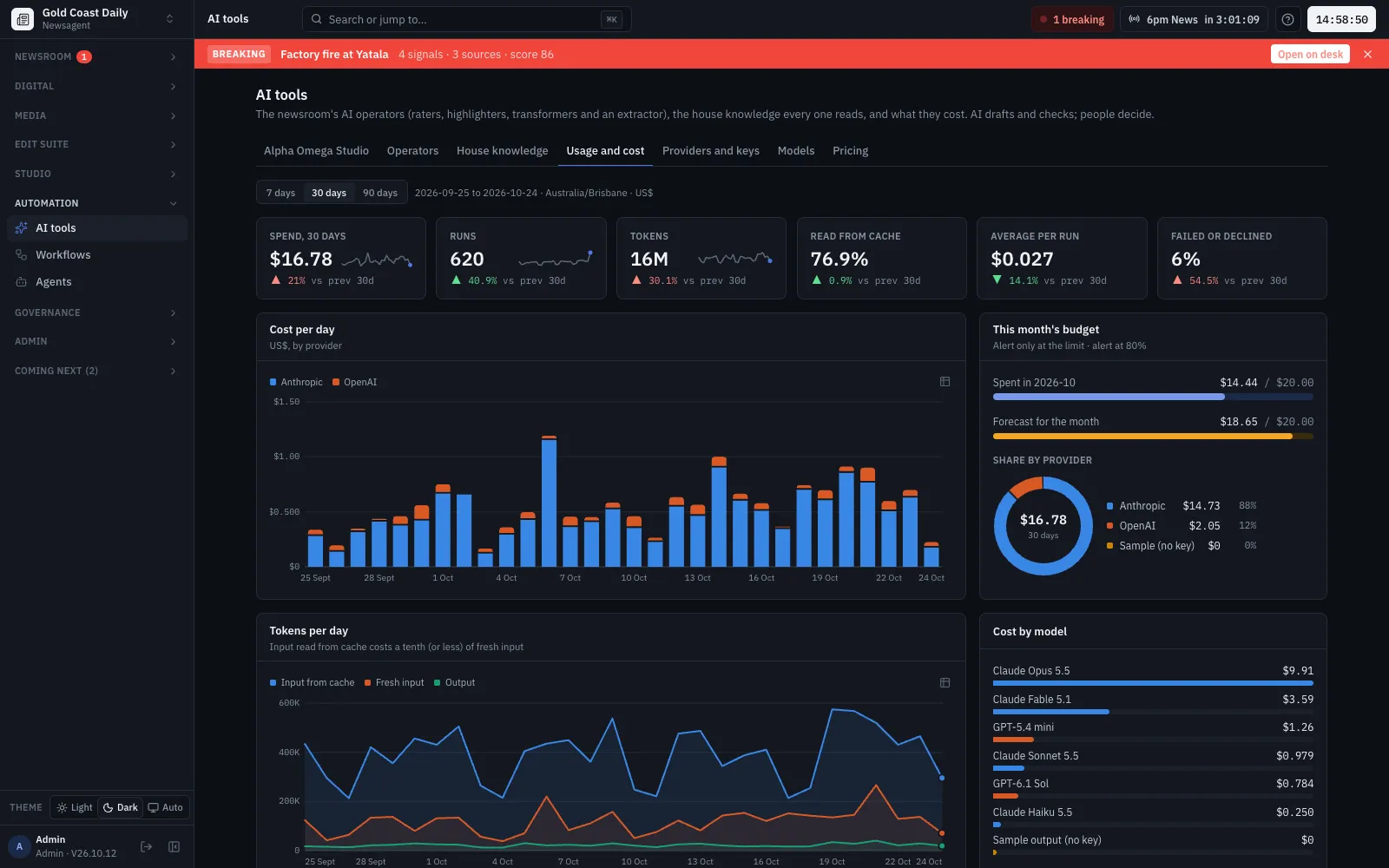
Each newsroom brings its own Anthropic and OpenAI keys and chooses which model does which job. Every run records the model, the tokens and what it cost.
- Keys encrypted at rest, never shown again after saving, tested when saved
- A model per tier (fast, standard, deep) and per tool, from the models your keys can use
- List prices built in and editable for negotiated rates
- Usage and cost by day, provider, model, tool and story
- A monthly budget with an alert, and an optional hard stop
How it works
AI keys, models and cost
Beyond the story
AI across the newsroom
Briefs on breaking events
A short brief on a developing event from its signals, with its sources, ready for the desk to act on.
Transcription
Every clip transcribed with Deepgram or OpenAI: word timings, speaker turns, Australian English and your names and places as vocabulary, with captions to download.
AI presenter
Talking-head videos read from a story's script with HeyGen or D-ID. Labelled AI-generated, with a disclosure line, and blocked from air until an editor approves. Custom avatars need a recorded consent.
Agents
Multi-step agents for the breaking desk, rundowns, packaging, research and fact checking, which propose rather than act.
Guardrails on every call
Embargoes, confidential copy, personal data and planted instructions checked before any model sees the text.
A record of everything
Every AI run, agent step and workflow step in the AI register, with its model, cost, verdicts and who approved it.
Principles
How AI behaves in Newsagent
Suggestions, not overwrites
AI proposes changes; a journalist accepts, edits or dismisses each one. Nothing AI writes is published without a person approving it.
Grounded in the story
Tools work from the story, its linked sources and the house knowledge, and highlight the exact words they're talking about.
Accountable
Every run is recorded with its model, inputs, verdicts and cost, so you can see what AI did, when and for whom.
See it with your newsroom's stories
We'll walk your team through Newsagent with your own desks, shows and channels, and talk through how you'd run it.